
Expense Management Software for Real Estate Companies
Expense management software built for your team. Local compliance, real-time visibility.
The Hidden Cost Nobody Tracks
New York→ Los Angeles→ London→ Toronto→ Sydney→ Chicago→ Austin→ Boston→ Seattle→ Denver→ Atlanta→ Miami→ Dallas→ San Francisco→ Singapore→ New York→ Los Angeles→ London→ Toronto→ Sydney→ Chicago→ Austin→ Boston→ Seattle→ Denver→ Atlanta→ Miami→ Dallas→ San Francisco→ Singapore→ New York→ Los Angeles→ London→ Toronto→ Sydney→ Chicago→ Austin→ Boston→ Seattle→ Denver→ Atlanta→ Miami→ Dallas→ San Francisco→ Singapore→ New York→ Los Angeles→ London→ Toronto→ Sydney→ Chicago→ Austin→ Boston→ Seattle→ Denver→ Atlanta→ Miami→ Dallas→ San Francisco→ Singapore→ New York→ Los Angeles→ London→ Toronto→ Sydney→ Chicago→ Austin→ Boston→ Seattle→ Denver→ Atlanta→ Miami→ Dallas→ San Francisco→ Singapore→ New York→ Los Angeles→ London→ Toronto→ Sydney→ Chicago→ Austin→ Boston→ Seattle→ Denver→ Atlanta→ Miami→ Dallas→ San Francisco→ Singapore→ New York→ Los Angeles→ London→ Toronto→ Sydney→ Chicago→ Austin→ Boston→ Seattle→ Denver→ Atlanta→ Miami→ Dallas→ San Francisco→ Singapore→As a manager, you're well aware of the visible expenses your team incurs, but there's a hidden cost that often goes untracked: the time you and your team spend on expense management tasks. On average, a manager like you loses approximately 4.2 hours per week on these tasks, translating to $10,920 annually at a modest $50 hourly rate. For a small team of just three managers, this cumulative loss balloons to $32,760 per year. For a complete overview, see our expense management guide.
This time isn't lost in one fell swoop but is instead fragmented across the workweek, making it easier to overlook. For instance, you might spend 20 minutes on a Monday chasing down a missing receipt from a team member, another 15 minutes on Tuesday reviewing a single expense report for policy compliance, and a whopping 30 minutes on Friday afternoon approving all pending expenses. These small time investments add up, detracting from strategic activities.
5 Hidden Time Sinks in Expense Management
Beyond the obvious, there are several hidden time sinks that plague managers. Here are five of the most significant:
- Receipt Chasing: The average manager spends 10 minutes per day (50 minutes/week) tracking down missing or illegible receipts, costing $2,600/year at $50/hr.
- Manual Approval Processes: Without automation, approval times can skyrocket, with managers spending up to 5 minutes per receipt (e.g., 30 receipts/week = 2.5 hours/week, or $6,300/year).
- Policy Enforcement Disputes: Resolving policy violations or discrepancies can consume up to 2 hours/week ($5,000/year), especially without clear, automatically enforced policies.
- Integration and Data Entry: Manually syncing data with accounting software or entering expenses can eat away 3 hours/week ($7,800/year), highlighting the need for seamless integrations.
- Audit Preparation: The ad-hoc nature of manual expense tracking can lead to lengthy preparation for audits, often requiring 10 hours/month ($2,500/month or $30,000/year) to ensure compliance.
These hidden costs not only drain financial resources but also divert valuable time away from core business activities. For a team of three managers, the total hidden cost can exceed $100,000 annually when considering all these factors. Implementing an efficient AI-powered real estate expense management management system is crucial to recouping this loss. Solutions like Blissneat, with its AI-powered approval suggestions, offline receipt scanning, and smart workflows, can significantly reduce the time spent on these tasks, offering a tangible solution to this pervasive problem.
By understanding and addressing these hidden time sinks, you can make a strong case for investing in a streamlined expense management solution. For example, Blissneat's capabilities can reduce approval times from 12 minutes to just 8 seconds per receipt, and its AI Agent can auto-approve or flag expenses, saving an additional 2 hours/week. This not only recovers valuable management time but also enhances team productivity and reduces the financial burden of manual expense management.
Managing expenses for a team of 5-50 people can be a time-consuming task, taking away from more strategic responsibilities. Specifically, managers like you spend an average of 4+ hours/week on receipt approvals alone, translating to $10,900/year in potential productivity loss. This time is fragmented across several key activities, each crucial yet labor-intensive.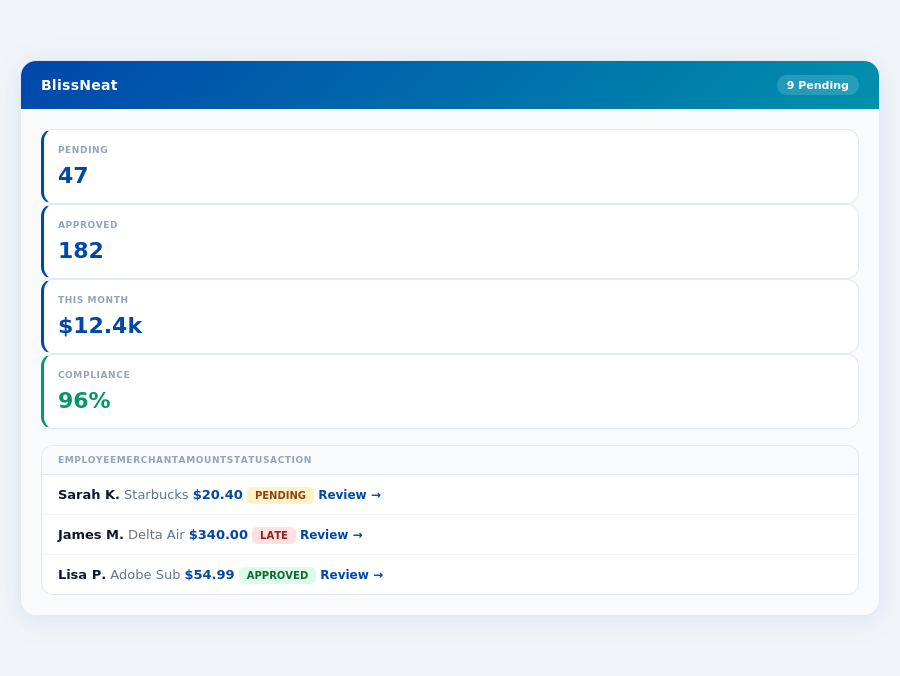
Chasing Receipts: The Never-Ending Hunt
Chasing missing receipts consumes 1.5 hours/week. This involves emailing employees, setting reminders, and sometimes, reconstructing expenses from memory or incomplete data. For instance, if your team of 20 submits an average of 5 receipts per week, missing just 10% of these (2 receipts) can lead to a significant hunt, assuming each chase takes about 15 minutes. This not only wastes time but also delays approval processes.Delays in receipt collection lead to:
- Delayed Approvals: Affects up to 30% of the monthly submissions if not managed promptly.
- Incomplete Records: Missing receipts can lead to inaccurate expense reporting, potentially affecting financial forecasts.
- Employee Frustration: Repeated requests demotivate employees, impacting overall team morale.
- Month-End Rush: Last-minute scrambles to gather all receipts increase the likelihood of errors or overlooked expenses.
Reviewing and Approving: The Tedious Middle Ground
Reviewing and approving expenses take 1.2 hours/week. This involves scrutinizing each receipt for policy compliance, a task that becomes increasingly cumbersome as the team grows. For a team of 30, with an average of 6 receipts per employee per week, manual review can lead to 36+ hours/month spent just on approvals, assuming 2 minutes per receipt. AI-powered tools like BlissNeat's can reduce this to mere seconds per approval.Manual approval processes are not only time-consuming but also prone to human error, with up to 5% of approvals potentially being incorrect due to oversight or fatigue. Implementing an automated system can significantly reduce this margin of error, ensuring compliance and saving valuable management time.
Month-End Reconciliation: The Final, Lengthy Check
0.8 hours/week are dedicated to ensuring all expenses are correctly accounted for before the month ends. This includes cross-checking approved expenses against financial records, a process that can uncover discrepancies or missed expenses. For teams using manual spreadsheets, this can involve comparing hundreds of entries across different documents, a task prone to errors.A automated expense management software system integrates seamlessly with accounting software (like QuickBooks or Xero), reducing reconciliation time by up to 90% and minimizing the risk of human error. This level of integration ensures that financial records are always up-to-date and accurate, streamlining the reconciliation process.
Policy Follow-Up: Ensuring Compliance
Ensuring policy compliance and following up on violations take 0.7 hours/week. This includes communicating policy updates to employees, handling exceptions, and sometimes, dealing with disputes. In teams without clear, automatically enforced policies, up to 15% of expenses might require additional review or correction.Implementing a system with automatic policy enforcement (like BlissNeat's) not only saves time but also reduces the incidence of policy violations by up to 40%, through immediate feedback to employees during submission. This proactive approach ensures that expenses are compliant from the outset, reducing the need for lengthy follow-ups. er/mo), the AI Agent takes autonomy to the next level, learning approval patterns to auto-approve or flag expenses, alongside features like employee nudging and reminders, which can reduce late submissions by up to 40%. This not only saves time but also enhances the overall approval process's accuracy and consistency.
Time Savings Breakdown
The cumulative effect of these features is substantial, with managers saving an average of 4.2 hours per week, equivalent to about 30 minutes per day. This translates to an annual saving of $10,900, considering an average manager's hourly rate. Here’s how these savings are typically distributed across different aspects of expense management:
- Approval Process: 1-click approval saves 3 hours/week (8 seconds vs 12 minutes per approval, assuming 60 approvals/week)
- Policy Enforcement: Auto flagging saves 0.5 hours/week by reducing manual review time
- Report Generation: Real-time dashboard eliminates the need for manual report compilation, saving 0.5 hours/week
- Employee Reminders (Enterprise): Reduces follow-ups by 1 hour/week
- Manual Data Entry Reduction: Offline scanning and AI suggestions save 0.7 hours/week
- Audit Preparation: Automated trails and CSV/PDF exports save 0.4 hours/week
These time savings are not merely theoretical; they are backed by feedback from our existing clients who have seen a significant reduction in the administrative overhead of expense management. By adopting BlissNeat, managers can reallocating this saved time towards more strategic activities, such as team development or business growth initiatives. Moreover, the scalability of our platform, supported by integrations with QuickBooks, Xero, and other major accounting software, ensures that as your team grows, our solution adapts seamlessly.
The ROI Math
BlissNeat's AI-powered expense management is designed to bring tangible financial benefits to your team. By automating receipt approvals, our solution saves managers an average of 4.2 hours per week. Translating this into monetary value, with an average hourly rate of $50, this equates to a yearly saving of $10,920 per manager (4.2 hours/week × $50/hr × 52 weeks).
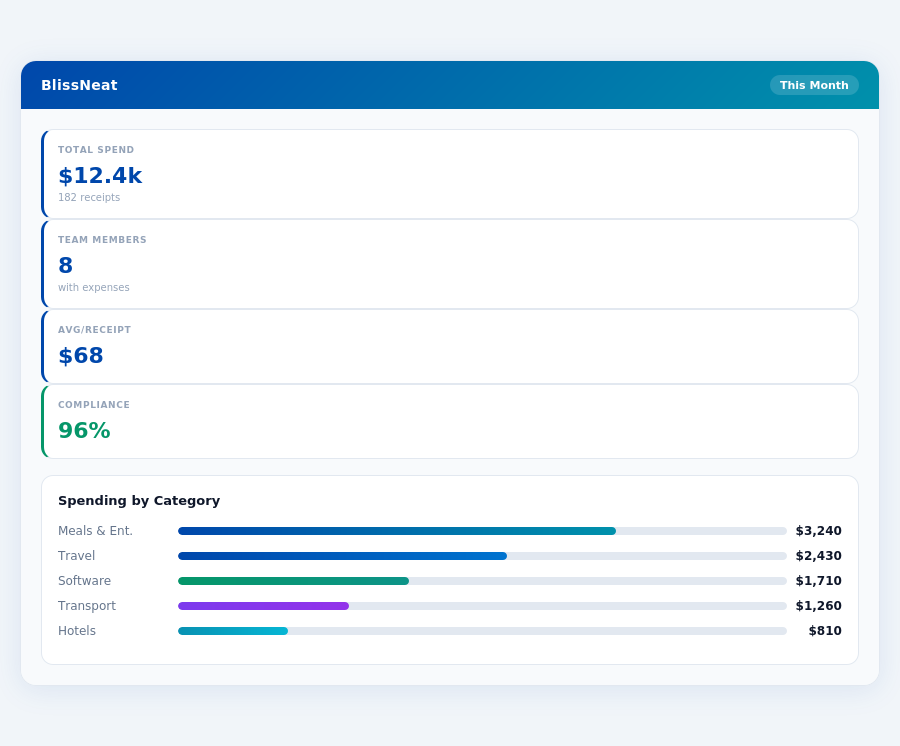
For a team of 25 users on our Pro plan, the annual cost is $5,700 ($19/user/mo × 25 users × 12 months). This results in a net saving of $5,220 per manager per year ($10,920 - $5,700), a direct return on investment. Additionally, BlissNeat accelerates reimbursement processes from 12 days to just 2, and boosts compliance rates to 96%, further enhancing operational efficiency.
ROI Breakdown and Additional Benefits
The ROI on BlissNeat Pro becomes positive from the first month of usage due to the significant time and cost savings. Beyond the financial ROI, BlissNeat offers several key operational benefits, including:
- Faster Reimbursement: Reduce wait times from 12 days to 2 days, improving employee satisfaction.
- High Compliance Rate: Achieve 96% compliance with automatic policy enforcement, reducing auditing headaches.
To illustrate the calculation clearly:
This detailed ROI analysis underscores the swift and substantial financial benefits of adopting BlissNeat for your expense management needs, coupled with enhanced operational efficiencies. With a positive ROI from the first month and ongoing savings, BlissNeat Pro is positioned to make a significant impact on your team's productivity and bottom line.
Below are four FAQ Q&A pairs about expense management time savings for managers, formatted as requested: 1. How Much Time Can Managers Save by Implementing Automated Enagement?Implementing automated expense management can save managers a significant amount of time, with averages suggesting a reduction of up to 5 hours per week per manager. This is achieved through the elimination of manual data entry, reduced need for physical document handling, and streamlined approval processes. For a team of 10 managers, this translates to 520 hours per year of time saved, which can be reallocated to strategic decision-making and team development. Automated systems also reduce errors, further saving time that would otherwise be spent on corrections.
2. What Time Savings Can Be Expected in Approval Processes with Digital Expense Management?Digital expense management systems can cut approval times by up to 70%, transforming what once took days into mere hours. Managers no longer need to physically review and sign off on expenses, as digital workflows facilitate instant notifications and one-click approvals. For an organization processing 200 expense reports monthly, this could mean saving 40 hours/month (or 480 hours/year) in approval-related administrative tasks alone, allowing managers to focus on higher-value activities like budget planning and forecasting.
3. How Does Automated Expense Reporting Impact Time Spent on Compliance and Auditing for Managers?Automated expense reporting significantly reduces the time managers spend ensuring compliance and preparing for audits. With all expenses digitally recorded and automatically checked against company policies, the time spent on compliance checks can be reduced by up to 90%. For a manager overseeing 50 employees, this might save 10 hours/month (or 120 hours/year) in compliance verification, and an additional 20 hours during annual audits due to the ease of producing detailed, accurate records. This reduction in administrative burden enables managers to dedicate more time to strategic oversight.
4. What Are the Long-Term Time Savings for Managers in Training and Onboarding with User-Friendly Expense Management Tools?User-friendly expense management tools drastically reduce the time managers spend training new staff and onboarding them to the expense reporting system. Initial training times can be slashed from 2 hours per new hire to under 30 minutes, thanks to intuitive interfaces. Over a year, for an organization hiring 20 new staff members, this results in 3.5 hours of training time saved for managers. Additionally, the reduced complexity leads to a 40% decrease in queries to managers about the expense process, freeing up an estimated 5 hours/month (or 60 hours/year) for more productive management activities, such as performance reviews and goal setting.
Related articles
Browse by team
See also: Expense sales legal london
See also: Expense field construction san francisco
See also: Expense small construction denver
See also: Expense small healthcare austin
Ready to manage expenses like a pro?
30-day free trial · No credit card · Setup in 15 minutes