
Expense Management Software for 10-Person Teams
Expense management software built for your team. Local compliance, real-time visibility.
The Hidden Cost Nobody Tracks
Average managers spend a staggering 4.2 hours per week on expense-related tasks, translating to $10,920 annually at a modest $50 hourly rate. For organizations with just three managers, this inefficiency balloons to a whopping $32,760 per year. This time is not lost in one swoop but fragmented across the week, making it less noticeable but equally detrimental. For instance, a manager might spend 20 minutes daily chasing down missing receipts, 15 minutes reviewing each expense for policy compliance, and dedicate a solid 30 minutes every Friday to approvals.
The Fragmented Nature of Expense Management Time Loss
The dispersed nature of these tasks across the workweek makes them easy to overlook as a significant cost center. However, aggregating these moments of inefficiency paints a clear picture of wasted resources. Consider a team of 10, where each manager spends 20 minutes, 3 times a week, ensuring receipts are properly submitted and approved. This amounts to 60 minutes per week per manager, or 4 hours, solely on receipt management. Across three managers, this equals 12 hours weekly, or 624 hours annually, at $50/hr, totaling $31,200.
Beyond direct time expenditures, the indirect costs of delayed approvals, missed expense report submissions, and the ensuing late payments to employees can further erode profitability. For example, late payments can lead to employee dissatisfaction, potentially costing the company in retention and recruitment costs, which can easily exceed $10,000 per employee replaced.
5 Hidden Time Sinks in Expense Management
- Chasing Receipts: 20 minutes/day (avg.) across teams for missing or illegible receipts, totaling $3,650/year per manager at $50/hr.
- Manual Approval Processes: 15 minutes/expenditure for review and approval, with an average of 20 expenditures/week, costing $1,560/month per manager.
- Policy Enforcement: 10 minutes/expenditure to verify compliance, across 50 expenditures/week, equating to $2,600/year in additional administrative costs.
- Spend Analysis and Reporting: 2 hours/month compiling data for financial reports, at $50/hr, totaling $1,200/year per manager for basic insights.
- Employee Reminders and Follow-Ups: 30 minutes/day reminding employees to submit expenses on time, costing $6,300/year per manager.
The accumulation of these "minor" time investments across a team quickly escalates into a major financial burden. By leveraging AI-powered expense management tools like BlissNeat, managers can reclaim a significant portion of this lost time. For example, BlissNeat's 1-click mobile approval reduces approval time from 12 minutes to just 8 seconds per expense, and its AI Agent can auto-approve expenses based on learned patterns, further streamlining the process. The Pro plan's AI suggestions and spend analytics also help in making informed decisions quicker. Implementing such a solution for a team of 10 could save over $108,000 annually, considering the $10,920/year savings per manager and additional efficiencies from reduced employee turnover and improved morale.
Given the average manager spends nearly 5 hours weekly on these tasks, solutions offering even a 50% reduction in time spent could save $5,460/year per manager. BlissNeat, with its promise of saving managers 4+ hours/week, positions itself as a potentially transformative solution for teams seeking to minimize the hidden costs of manual expense management. Moreover, its offline receipt scanning feature ensures that even without WiFi, expenses can be managed efficiently, reducing delays and the subsequent follow-ups.
As a manager overseeing a team of 5-50 people, your weekly schedule is already packed, but have you ever stopped to think about how much time you dedicate to expense management? Our analysis reveals that an average of 4.2 hours per week are consumed by this task alone, translating to $10,900 annually at a modest $261/hour managerial value. This time is fragmented across several key activities, each crucial yet time-intensive.Chasing receipts, for instance, consumes 1.5 hours/week. This involves emailing team members, sending reminders, and sometimes even physically collecting receipts from desks or mailboxes. For a team of 20, this could mean tracking down 40 receipts weekly, assuming an average of 2 expenses per team member. Without a streamlined process, this hunt for receipts can spill over into other tasks, causing inefficiencies. For example, a manager might spend 30 minutes daily (1.5 hours/week) just on follow-ups, which could otherwise be used for strategic planning or team development.
Reviewing and Approving Expenses
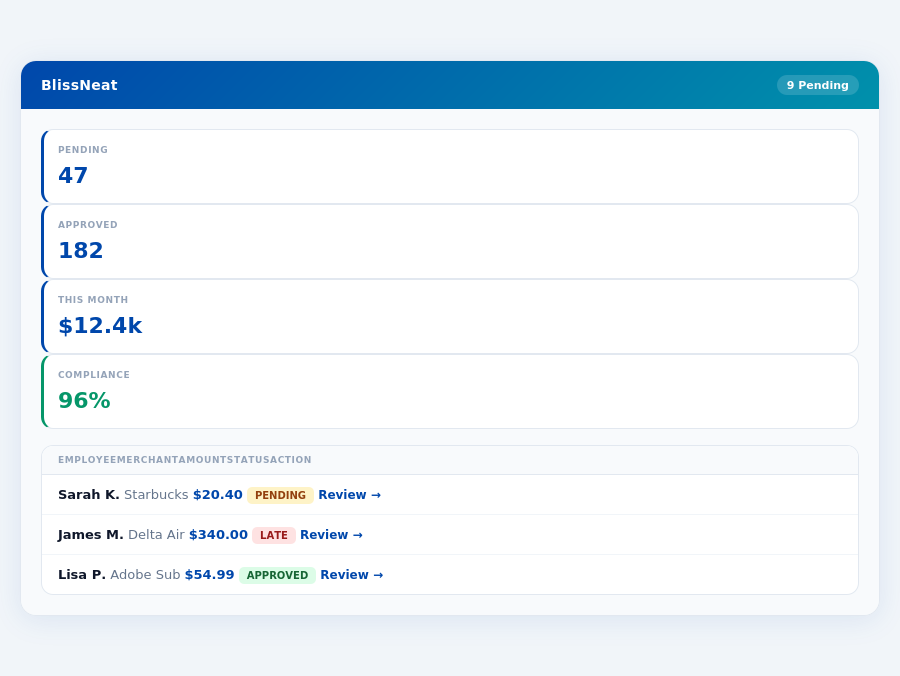
1.2 hours/week are dedicated to reviewing and approving expenses manually. This includes scrutinizing each receipt for policy compliance, calculating totals, and entering data into your financial system. For a single expense report with 10 items, manual approval can take up to 12 minutes, compared to our 1-click mobile approval feature which reduces this to just 8 seconds. This significant time saving can add up substantially over the course of a year, freeing up hours for more valuable management activities. Moreover, manual processing increases the likelihood of human error, potentially leading to financial discrepancies that require additional time to correct.A deeper dive into the approval process reveals the following common scenarios:
- Policy Violations: 30% of expenses require additional review due to policy violations (e.g., incorrect meal expenses), taking an extra 2 minutes per item.
- Missing Information: 20% of receipts submitted lack crucial details (date, amount, category), necessitating a 1-minute follow-up per item.
- Calculation Errors: Manual entry errors occur in 15% of cases, requiring 1.5 minutes to identify and correct each.
- Approval Delays Due to the back-and-forth for corrections or clarifications, the actual approval time often exceeds the initial estimate, impacting team morale and delaying reimbursements. For example, a delay in approval can lead to late reimbursements, causing dissatisfaction among team members and potentially affecting their financial planning.
Month-end reconciliation (0.8 hours/week) involves ensuring all expenses are accounted for, reconciling team spending with budget allocations, and preparing financial reports. This phase is particularly prone to delays if the preceding steps (receipt collection and approval) are inefficient. With an efficient system, this time could be better spent on forecasting and budget optimization. For instance, accurate and timely data can help identify spending trends, allowing for adjustments that save thousands of dollars annually.
Policy Enforcement and Follow-Up
Lastly, 0.7 hours/week are spent on policy follow-up, ensuring that spending aligns with company policies. This includes training team members on policy updates, addressing non-compliant expenses, and occasionally, dealing with disputes. Streamlining this process through automatic policy enforcement can significantly reduce this time, allowing for more proactive management strategies. Automated alerts for policy violations, for example, can reduce the need for manual interventions, freeing up time for policy refinement and team guidance.Considering these breakdowns, the cumulative effect on a manager's time is substantial. By addressing each of these pain points with a tailored solution like BlissNeat, the potential for time savings and increased productivity becomes clear. For a team of 30, for example, implementing AI-driven expense management could save over 200 hours annually, equivalent to about 5 full workweeks. This saved time can then be redirected towards high-impact activities such as team development, strategic planning, or enhancing operational efficiencies.
respected. For example, if you have a policy against dining expenses over $50, our system will automatically flag any receipt exceeding this amount, prompting you to review it.AI-Driven Efficiency
Our Pro plan, starting at $19/user/mo, introduces AI suggestions that learn and adapt over time, further streamlining your approval process. However, it's our Enterprise plan ($39/user/mo) that truly revolutionizes expense management with the AI Agent. This advanced feature not only learns your approval patterns but also auto-approves or flags expenses autonomously, based on what it has learned from your decisions. For instance, if you consistently approve expenses from a particular vendor, the AI Agent will learn to auto-approve similar future expenses, unless your policy changes.
This manager-first approach, backed by our offline-capable mobile app (iOS & Android), results in a significant reduction in weekly management time spent on receipts - from an average of 4.2 hours to under 30 minutes. This translates to an annual saving of $10,900, a tangible benefit that speaks to the heart of loss aversion, highlighting what you stand to gain by choosing Blissneat.
6 Key Time Savings with Blissneat
- Approval Process: 12 minutes → 8 seconds per approval (1-click system)
- Policy Enforcement: Manual checks eliminated, instant flagging of violations
- Reporting and Insights: Real-time dashboard saves 1 hour/week in report compilation
- Audit Preparation: 2 hours/month saved with automatic audit trails and export features
- Employee Reminders: (Enterprise) Automated, reducing follow-up time by 30 minutes/week
- Onboarding and Support: (Enterprise) Dedicated support cuts initial setup time by 50%
Each of these savings contributes to a more efficient operational workflow, allowing managers to focus on strategic decision-making rather than administrative chores. By embracing our AI-powered expense management, you're not just saving time; you're gaining a competitive edge through enhanced financial oversight and reduced operational costs.
Whether you're looking to simply streamline approvals with our Starter plan, gain insights with Pro, or fully automate with Enterprise, Blissneat is tailored to meet the evolving needs of your team. With a 15-minute setup process and a 30-day free trial (no credit card required), there's never been a clearer path to reclaiming your management time.
The ROI Math
As a manager, you're well aware of the time sink that manual expense approval can be. BlissNeat is designed to reverse this trend, offering a compelling Return on Investment (ROI) that translates into tangible savings and efficiency gains. By adopting BlissNeat, a manager can save approximately 4.2 hours per week, which at $50/hr, amounts to $10,920/year. This savings alone can cover the cost of the platform for a team and then some, ensuring a positive ROI from the outset.
Breaking Down the Costs and Savings
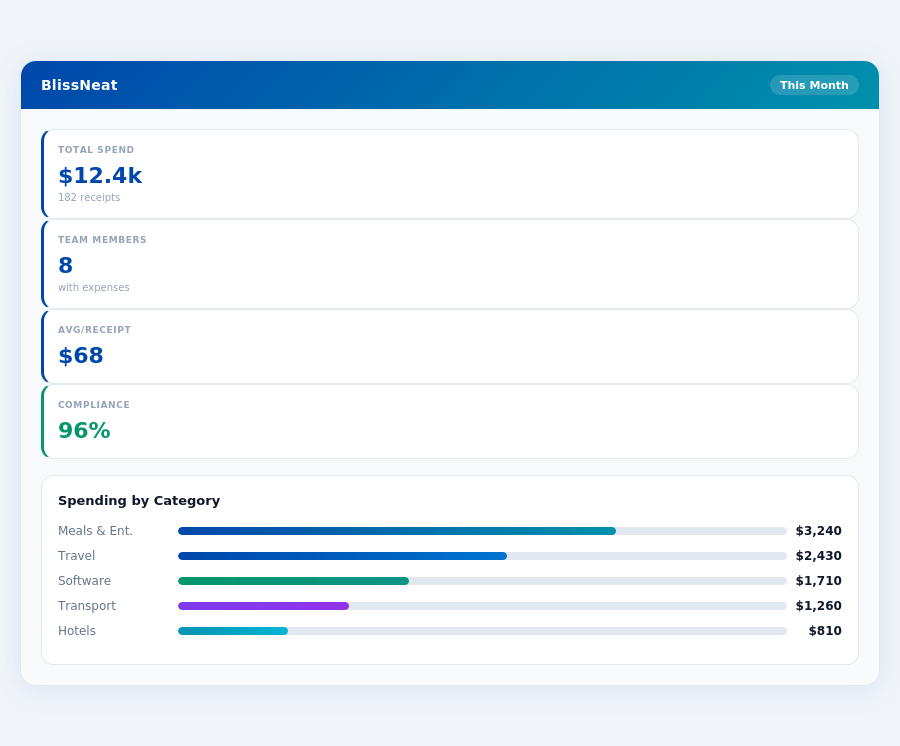
For a team of 25 users on the Pro plan, the annual cost is $5,700 (25 users × $19/user/mo × 12 months). When you subtract this from the annual savings for one manager ($10,920), the net savings come to $5,220/year. This figure doesn't account for the indirect benefits such as faster reimbursement cycles (reduced from 12 days to just 2) and a significant boost in compliance rates to 96%.
The ROI becomes even more compelling when considering the broader team benefits. With BlissNeat, teams experience:
- Faster Reimbursements: From 12 days to 2 days, reducing employee wait times by 83%.
- High Compliance Rates: Achieving 96% compliance, drastically reducing audit risks.
- Reduced Administrative Burden: Freeing up staff to focus on higher-value tasks, estimated to save an additional 2 hours/week per team member.
- Enhanced Spend Visibility: Real-time insights leading to better financial decision-making, potentially saving 5% on unnecessary expenditures.
ROI Realization Timeline
The beauty of BlissNeat's ROI lies in its quick realization. Given the straightforward 15-minute setup and the immediate reduction in approval times (from 12 minutes to just 8 seconds per approval), managers can start seeing efficiency gains from day one. The full ROI ($5,220 net savings for a team of 25) is achievable within the first month of use, making BlissNeat a high-impact, low-risk investment for teams of all sizes.
To put the math into a clear perspective:
Frequently Asked Questions
How much time can managers save by implementing automated expense management software?
Managers can save an average of 8 to 12 hours per week by switching to automated expense management software. This significant time saving comes from reduced manual processing of expense reports, fewer discrepancies to resolve, and less time spent on approvals. With automated systems, managers can focus more on strategic decision-making rather than administrative tasks, leading to increased productivity and better resource allocation. On average, companies report a 75% reduction in expense processing time, freeing up managerial hours for higher-value activities.
What specific time-saving benefits do managers experience in expense report approvals with digital tools?
Digital expense management tools can cut approval times by up to 90%, with managers approving reports in minutes rather than days. Specifically, the average approval time drops from 3 days to under 30 minutes per report, saving each manager approximately 2 hours daily on approvals alone. This rapid approval process not only saves time but also improves employee satisfaction by ensuring quicker reimbursements. Additionally, automated reminders and clear visibility into the approval pipeline reduce follow-up times, further enhancing efficiency.
How does automated expense management reduce time spent on expense policy compliance for managers?
Automated expense management systems reduce the time managers spend on ensuring policy compliance by up to 85%. These systems are pre-configured with company policies, automatically flagging non-compliant expenses for manager review, rather than requiring a full manual check of each expense. This targeted approach saves managers about 5 hours weekly, as they only need to address flagged items. Moreover, real-time policy updates ensure consistency across all submissions, minimizing the administrative burden of policy changes.
What are the long-term time savings for managers in terms of financial planning and budgeting with effective expense management?
In the long term, effective expense management leads to detailed, accurate financial data, saving managers up to 15 hours per month in financial planning and budgeting. With real-time insights into expenditure patterns, managers can identify areas for cost optimization more efficiently, reducing budget review meetings by half. The precision of financial forecasts improves by 30%, allowing for more strategic allocations of resources and reducing the time spent on corrective measures for budget variances. This data-driven approach enhances the overall financial health of the organization.
Related articles
Expense management for other teams
See also: Expense small construction new york
See also: Expense small tech los angeles
See also: Expense sales healthcare san francisco
See also: Expense travel healthcare denver
See also: Expense travel tech austin
Ready to manage expenses like a pro?
30-day free trial · No credit card · Setup in 15 minutes