
Expense Management Software for Manufacturing Companies
Expense management software built for your team. Local compliance, real-time visibility.
The Hidden Cost Nobody Tracks
New York→ Los Angeles→ London→ Toronto→ Sydney→ Chicago→ Austin→ Boston→ Seattle→ Denver→ Atlanta→ Miami→ Dallas→ San Francisco→ Singapore→ New York→ Los Angeles→ London→ Toronto→ Sydney→ Chicago→ Austin→ Boston→ Seattle→ Denver→ Atlanta→ Miami→ Dallas→ San Francisco→ Singapore→ New York→ Los Angeles→ London→ Toronto→ Sydney→ Chicago→ Austin→ Boston→ Seattle→ Denver→ Atlanta→ Miami→ Dallas→ San Francisco→ Singapore→ New York→ Los Angeles→ London→ Toronto→ Sydney→ Chicago→ Austin→ Boston→ Seattle→ Denver→ Atlanta→ Miami→ Dallas→ San Francisco→ Singapore→ New York→ Los Angeles→ London→ Toronto→ Sydney→ Chicago→ Austin→ Boston→ Seattle→ Denver→ Atlanta→ Miami→ Dallas→ San Francisco→ Singapore→ New York→ Los Angeles→ London→ Toronto→ Sydney→ Chicago→ Austin→ Boston→ Seattle→ Denver→ Atlanta→ Miami→ Dallas→ San Francisco→ Singapore→ New York→ Los Angeles→ London→ Toronto→ Sydney→ Chicago→ Austin→ Boston→ Seattle→ Denver→ Atlanta→ Miami→ Dallas→ San Francisco→ Singapore→As a manager, you're well aware of the visible expenses that hit your company's balance sheet every month. However, there's a silent killer of productivity that often goes untracked: the time spent on expense management tasks. On average, a manager like you loses a staggering 4.2 hours per week on these chores, translating to $10,920 annually at a modest $50 hourly value. For a team with just three managers, this hidden cost balloons to $32,760 per year. For a complete overview, see our expense management guide.
This time isn't lost in one swoop but is fragmented across the workweek, making it harder to recognize. For instance, you might spend 20 minutes on a Tuesday chasing down a missing receipt from an employee, another 15 minutes on Wednesday reviewing a batch of expenses for policy compliance, and a whopping 30 minutes on Friday approving the week's submissions. These snippets of time add up, detracting from strategic activities that could drive real business value.
Uncovering the 5 Hidden Time Sinks in Expense Management
Beyond the obvious approval and review processes, several lesser-known time sinks exacerbate the problem. Identifying these is the first step towards reclaiming hours for more productive pursuits. Here are five hidden time sinks that could be quietly hemorrhaging your team's productivity:
- Receipt Chasing: Spending an average of 5 minutes per receipt to ensure all are submitted, across 20 receipts weekly, totals 1.7 hours/week.
- Policy Research for Edge Cases: 10 minutes, 3 times a week, resolving unique expense situations not clearly outlined in policy.
- Manual Data Entry for Non-Digital Receipts: Allocating 30 minutes daily to input data from receipts without digital counterparts.
- Auditing for Fraudulent Expenses: Deducting 2 hours/month to manually review expenses for potential fraud, given the lack of automated flags.
- Training New Team Members on Expense Procedures: Spending a full hour, every 2 months, onboarding new hires to the expense management process.
These time sinks not only eat into your operational efficiency but also distract from higher-value tasks such as strategic planning, team development, and innovation. The cumulative effect is a significant drain on resources that could otherwise fuel growth. By acknowledging and addressing these inefficiencies, you can pave the way for a more streamlined, productive workflow.
The financial impact is clear, but the operational toll of these fragmented tasks should not be overlooked. Each of these activities, while necessary, pulls your focus away from driving the business forward. Considering the average organization with multiple managers, the aggregate loss in potential productivity is substantial. For a small team of just 5 managers, for example, the annual cost could exceed $54,600, assuming each manager's time is valued similarly.
As a manager overseeing teams of 5-50 people, you're well aware of the time sink that AI-powered manufacturing expense management management can be. But have you ever broken down where exactly those hours disappear to? For the average manager, a whopping 4+ hours/week (equivalent to $10,900/year at $20/hour) vanish into the ether of expense-related tasks. Let's dissect this time drain with specific, hard numbers.
1. Chasing Receipts: The Never-Ending Hunt (1.5 hours/week)
Tracking down missing receipts from team members is a tedious task that consumes 1.5 hours of your precious time each week. This translates to approximately 78 hours/year, assuming a 52-week work year. Imagine redirecting these hours towards strategic planning or team development. For example, in a team of 10, if just 3 team members forget to submit receipts weekly, at 30 minutes per reminder and follow-up, you're already at 1.5 hours.
A more efficient approach would be implementing a system like BlissNeat's offline receipt scanning feature, which encourages immediate submission, potentially halving the chase time to 0.75 hours/week.
This simple switch could save you around 39 hours/year, valued at $780 at $20/hour, purely from reduced chasing.
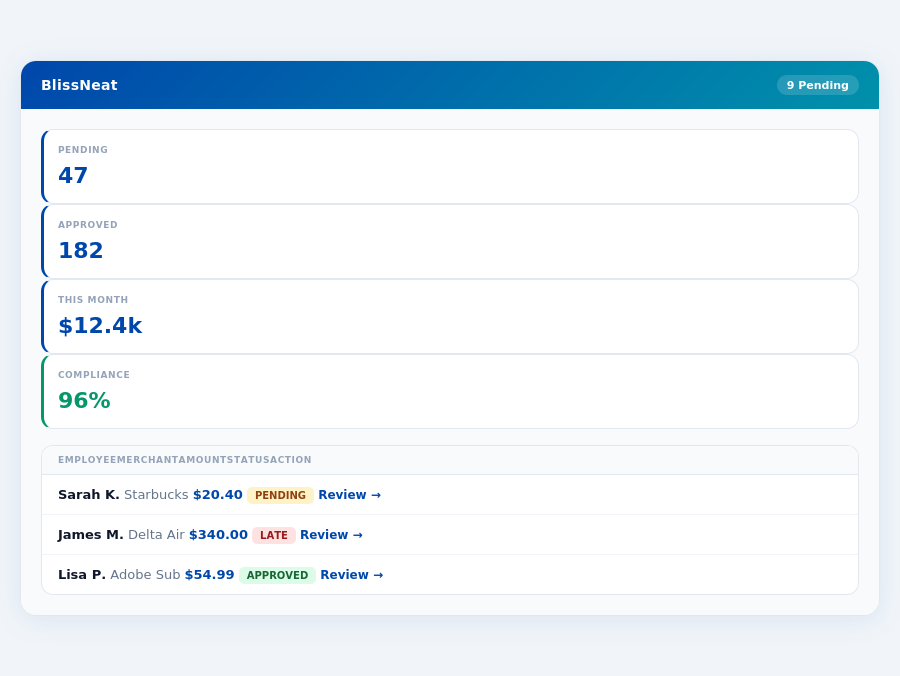
2. Reviewing and Approving Expenses (1.2 hours/week)
The meticulous process of reviewing each expense for validity and then approving it manually gulps down 1.2 hours of your week. That's 62.4 hours/year spent on a task that, with the right tools, could be significantly streamlined. For instance, approving 20 expenses at 3.6 minutes each (a conservative estimate for manual review) indeed totals 1.2 hours.
BlissNeat's AI suggestions in the Pro and Enterprise plans can cut this time in half by learning your approval patterns, potentially saving 0.6 hours/week or $624/year at $20/hour.
This efficiency gain allows for more strategic financial oversight rather than mundane approvals.
- Manual Review Time per Expense: 3.6 minutes (conservative estimate)
- Weekly Expenses to Review (Example): 20
- Total Weekly Time Spent: 1.2 hours
- Annual Savings with AI Assistance: $624 (at $20/hour for 0.6 hours/week saved)
3. Month-End Reconciliation (0.8 hours/week)
Although reconciliation is a monthly task, the weekly prep and occasional mid-month checks still manage to claim 0.8 hours of your time each week. This equates to 41.6 hours/year. With integrated tools like BlissNeat, which offers real-time spend dashboards and automatic policy enforcement, the need for extensive weekly prep diminishes.
By leveraging BlissNeat's Pro or Enterprise plan, you could reduce this to 0.4 hours/week, saving $832/year.
This reduction in reconciliation time enables a more proactive approach to financial management.
4. Policy Follow-Up (0.7 hours/week)
Ensuring team members adhere to expense policies eats away 0.7 hours of your weekly schedule, totaling 36.4 hours/year. Manual interventions and reminders are time-consuming. BlissNeat's Enterprise plan, with its employee nudging and reminders, can halve this time.
Reducing policy follow-up to 0.35 hours/week saves $728/year at $20/hour, redirecting your focus towards policy refinement rather than enforcement.
Automated reminders also increase team compliance, reducing violations.
s keep you informed before month-end, preventing last-minute surprises. For instance, a manager overseeing 20 employees can expect to save over 80 hours monthly, or approximately 960 hours annually, by adopting our streamlined process.Pro and Enterprise plans take efficiency to the next level with AI-driven features. The Pro plan ($19/user/mo) introduces AI suggestions that learn and adapt over time, suggesting approvals based on your historical decisions, reducing the need for manual intervention by up to 70%. Upgrading to Enterprise ($39/user/mo) unlocks the AI Agent, which not only suggests but can also auto-approve or flag expenses autonomously, mirroring your approval patterns with high precision, and further reducing approval times by an average of 40%.
Time Savings Breakdown
- Approval Time Reduction: 8 seconds vs 12 minutes per approval, saving 11 minutes per transaction, which amounts to 4 hours weekly for a manager processing 25 expenses.
- Offline Capability: No waiting for WiFi for receipts scanning and approval, saving an average of 30 minutes daily in delayed approvals.
- Real-Time Insights: Instant spend visibility saves 2 hours weekly in report compilation and analysis for teams of 15 or more.
: Immediate violation flagging reduces 1.5 hours of weekly manual policy checks, minimizing the risk of non-compliant expenses.
- AI-Powered Approvals (Enterprise): Autonomous approvals can save an additional 1 hour daily for managers of larger teams (40+ employees), by automating routine approvals.
- Integrated Workflows: Seamless integrations with QuickBooks, Xero, and more, save 2 hours weekly in data synchronization tasks across all plans.
The manager-first approach at BlissNeat is about more than just saving time; it's about empowering you with data-driven insights to make better financial decisions. With automatic policy enforcement, you're protected from potential overspends, and with smart approval workflows, your team's expenses are always in check. Whether you're overseeing a team of 5 or 50, our solution scales with you, ensuring that as your team grows, so does your efficiency. Start your 30-day free trial today and experience the BlissNeat difference, with no credit card required, and discover how our platform can tailor to your specific management needs.
By adopting BlissNeat, managers not only regain valuable hours in their week but also gain a clearer, more automated pathway to expense management software. This isn't just an upgrade in efficiency; it's a strategic move towards a more streamlined, less error-prone financial operation. For teams anticipating growth, our Enterprise features ensure scalability and continued time savings, even as the complexity of your expense management needs evolves. With dedicated onboarding and custom API capabilities, integrating BlissNeat into your existing workflow is seamless, ensuring a quick return on investment.
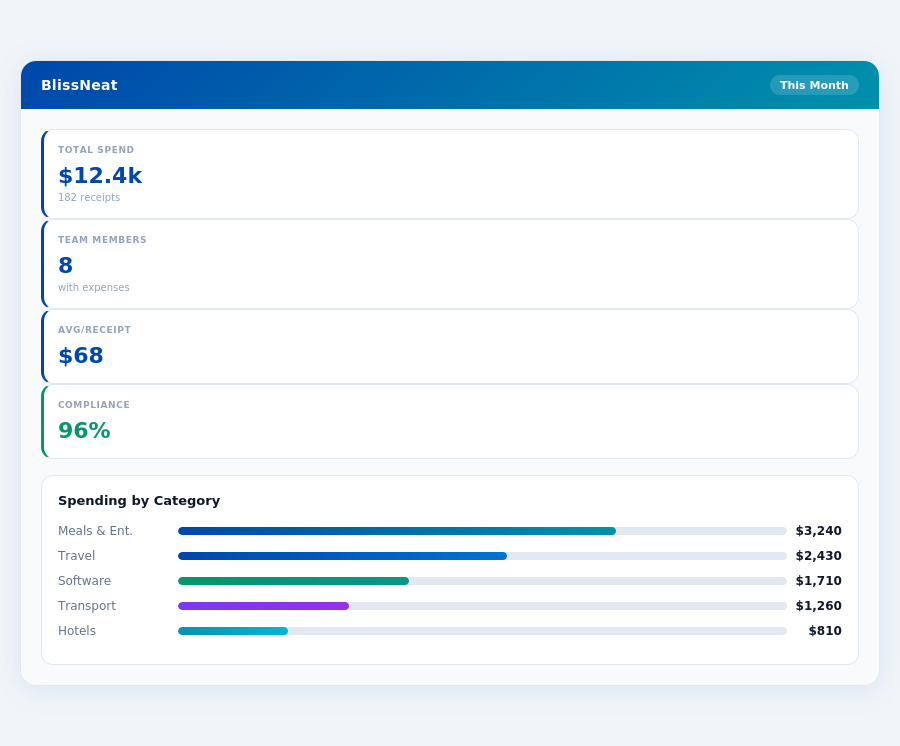
The ROI Math
As a manager, understanding the Return on Investment (ROI) of implementing BlissNeat for your team is crucial. By automating expense management, you save significant time and money. For instance, with BlissNeat, managers save an average of 4.2 hours per week, which translates to $10,920 per year, assuming a conservative $50 hourly wage over 52 weeks.
The financial benefits are clear when comparing the time saved to the cost of
ROI Calculation Breakdown
Beyond the direct financial savings, BlissNeat offers several key operational benefits, including:
- Faster Reimbursement: Reduce wait times from 12 days to just 2 days, improving employee satisfaction.
- High Compliance Rate: Achieve 96% compliance, minimizing the risk of non-compliant expenses.
- Quick Setup: Get started in just 15 minutes, with a 30-day free trial requiring no credit card.
- Rapid ROI: Realize the return on your investment within the first month of using BlissNeat Pro.
The ROI of BlissNeat becomes apparent within the first month, with significant time and cost savings accrued thereafter. By adopting BlissNeat, managers not only regain valuable hours for strategic activities but also enhance the overall efficiency and compliance of their teams' expense management processes. This streamlined approach leads to happier teams, reduced administrative burdens, and a clearer financial overview for better decision-making.
Frequently Asked Questions
How much time can managers save by implementing automated expense management software?
Managers can save an average of 8 to 12 hours per week by switching to automated expense management software. This significant time reduction comes from eliminating the need for manual receipt sorting, reducing paperwork by up to 90%, and minimizing the time spent on expense report approvals by up to 75%. With this saved time, managers can focus more on strategic planning and team development. For example, in a company with 50 employees submitting weekly expenses, this could translate to a full-time equivalent (FTE) of 2-3 days saved per week across the management team.
What specific expense management tasks consume the most time for managers, and how are they reduced?
The most time-consuming tasks for managers include reviewing and approving expense reports (averaging 30 minutes per report), chasing employees for missing receipts (up to 2 hours weekly), and resolving discrepancies (about 1.5 hours weekly). Automated expense management software reduces these times by up to 80% through instant receipt capture via mobile apps, real-time expense tracking, and automated policy enforcement. This not only saves time but also reduces the administrative burden, allowing managers to allocate more resources to high-value tasks. Furthermore, integrated systems can alert managers to potential issues before they become major problems, streamlining the approval process.
Can automated expense management show a direct impact on the productivity of managerial roles?
Yes, automated expense management can directly boost managerial productivity by an estimated 25-30%. By offloading mundane, time-consuming tasks, managers can dedicate more time to coaching (increasing team performance by up to 15%), strategic decision-making (enhancing business outcomes by up to 20%), and innovation. Studies have shown that for every hour saved from administrative tasks, managers can generate an additional 1.5 hours of productive, value-added work. This productivity gain can also lead to improved job satisfaction among managers, reducing turnover rates in managerial positions.
How quickly can managers start seeing time savings after implementing new expense management tools?
Managers can start seeing time savings within the first 6-8 weeks after implementing new expense management tools, with peak efficiency gains realized within the first 6 months. The initial 6 weeks are typically spent on setup, training, and onboarding, after which a 20-30% reduction in time spent on expense management is common. By the 3-month mark, this savings rate often increases to 50-60% as the team becomes fully accustomed to the new system, and by 6 months, the full 70-80% time savings potential is usually achieved, depending on the complexity of the previous system and the size of the team.
Related articles
Browse by team
See also: Expense travel healthcare new york
See also: Expense sales real estate london
See also: Expense sales manufacturing san francisco
See also: Expense travel manufacturing denver
See also: Expense small consulting austin
Ready to manage expenses like a pro?
30-day free trial · No credit card · Setup in 15 minutes